Intro: I first posted this as it was happening and figured once all the accounts had been suspended, that would be the end of it. But no. The idiot(s) behind this scam keep coming back for more. So it starts as near real time, but now it’s daily updates until these losers realize they lost.
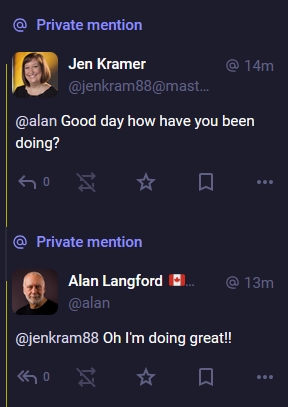
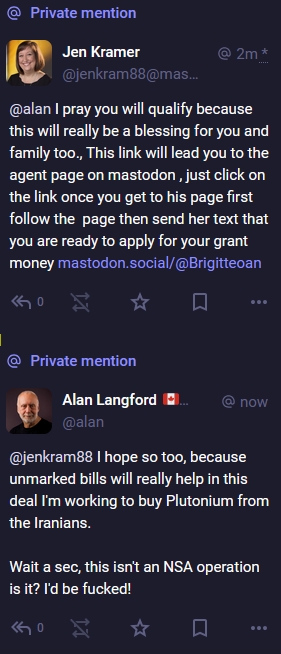
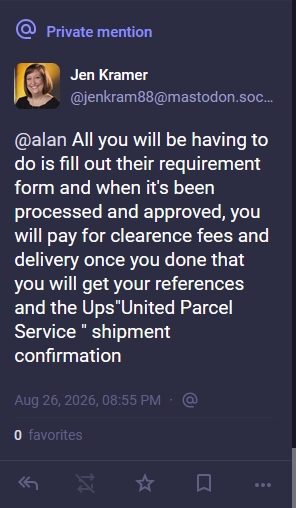
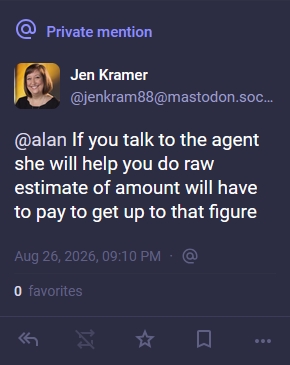
I follow a friend from back in my Joomla days, Jen Kramer. So far I’ve had two fake Jen Kramer accounts follow me from mastodon.social. So I thought I’d have a little fun with the second one (I figure I’d make use of the lag time after reporting the account.) So here’s the “transcript” (images have alt text).
Sure, like Jen would randomly ask me this question after 15 years or so.
Good old Department of Health and Human Services program “going on yet.” I guess that Canadian flag in my name wasn’t enough of a clue, so we have a real winner here: we don’t have a DHHS.
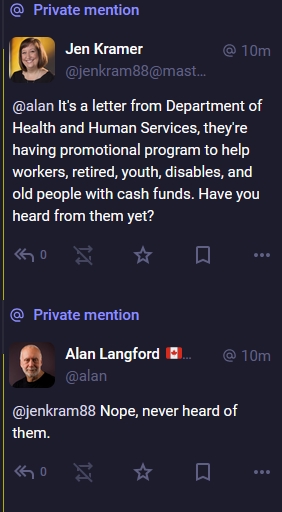
Nothing like helping the “disables.”
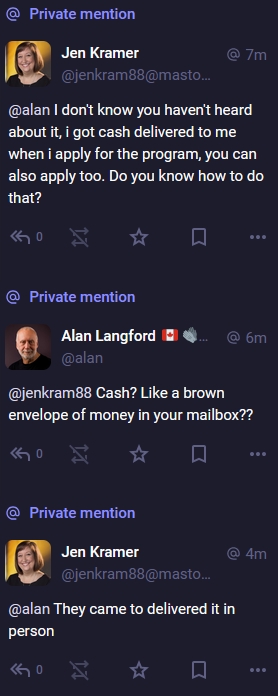
Ooh cash. I like cash.
I am really trying to give this idiot a clue here.
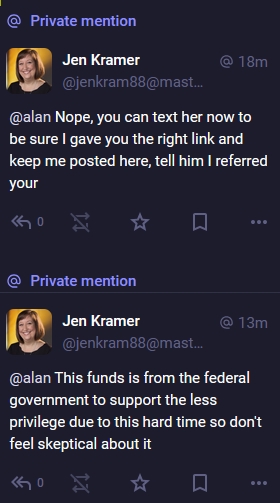
Really. You would think this would do it. But the key here is the link to the second account, which appears to be someone who hasn’t posted since 2024. Probably a compromised by a brute force password attack. FFS people, pick hard to guess passwords!!!
I’m assuming this idiot only gets paid when I message the second level scammer…
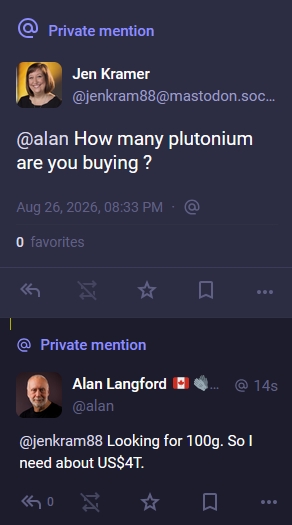
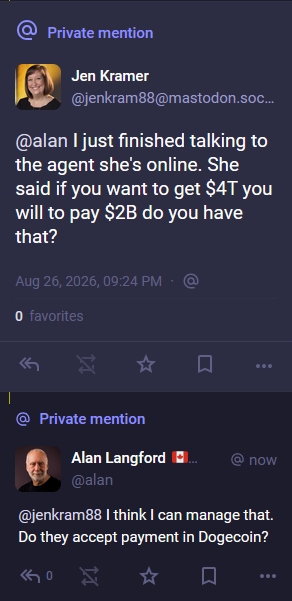
Yes, I only need four trillion dollars. This idiot didn’t clue in even then.
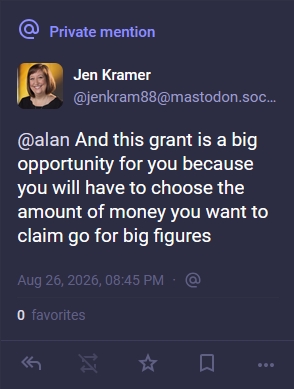
Big figures like four trillion? LOL
There it is “clearance fees.” Well I guess I can cough up a few thousand for a trillion bucks from a foreign agency…
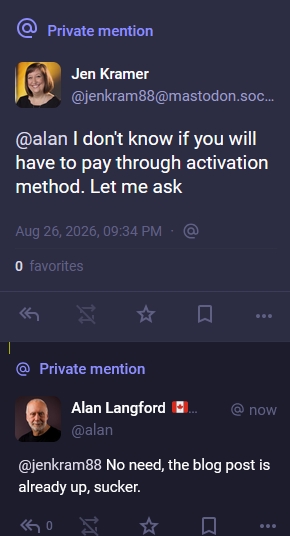
At this point I have stopped responding so this turkey is trying hard to keep me on the hook, even though he’s already given away the scam. But then it gets better:
There’s probably going to be more of this, but I want to get this posted.
Oh. And in the middle of this I pinged the second hacked account:
But for some utterly inexplicable reason I haven’t gotten a response!
Addendum: I just got tired of this. 😉
Addendum 2: Just after posting this, I reported the second account. Some 15 minutes later, both accounts have been suspended, and this is why I love the fediverse. Real human moderation, and timely!
Addendum 3: Another ten minutes later, I get followed by a brand new fake Jen account. What does the account do? Well, it boosts real Jen’s most recent posts to make it look like it’s real, and the first one is her mentioning this post. So we can conclude that it’s a bot that’s creating these accounts.
Addendum 4: Two days and several fake Jen Kramers later, this idiot still thinks he has a mark…
Incredible!
Addendum 5: But wait, there’s more! LOL Another day and these idiots are still trying to pick up the scam.
The only remaining question is “Will there be a Fake Jen number nine?” Stay tuned…
Addendum 6: Fake number 9 showed up on September 6 (LOL) eleven days after first being abused, this idiot is still at it.
I didn’t have a chance to hurl more abuse though. I didn’t see the message for two hours, and by that time the moderation folks at mastodon.social had suspended the account. Gotta love moderation on the fediverse! Also of note, they’ve picked up Jen’s new profile image. I’m guessing there will be more to this thread…
Tobias Lütke, CEO of Shopify, thinks “weighted voting proportional to the level of income tax you pay,” is a good system. Drop “income” out of that and he’s right!
The problem is, like many others who have reached a level of wealth in the billions, he sees everything as a business venture. But government is not a business, it’s a mechanism for providing services.
I’d like to suggest that proportional voting is a good idea, but the basis for weighting votes should be the amount of burden a taxpayer absorbs in running it. The “all taxes suck” right wing propaganda think tanks love to point out that for the average Canadian “tax freedom day” falls somewhere near the middle of the year, so let’s use that as a baseline.
While people who earn less than the average pay less income taxes, they pay a disproportionately large amount of tax when you consider that “all taxes combined, hidden or otherwise” version that the anti-tax people tout. For an example, let’s take someone who buys 2,000 litres of gas over the course of a year at an average $1.50/l. That’s $3,000 spent on gas. The anti-tax people happily point out that half or more of that is hidden taxes, so we’ll call that $1,500 in taxes for the year. For someone who makes $150,000 a year, that’s 1% of gross income. For someone making just $50,000 it’s 3%. Even at higher marginal income tax rates, “tax freedom day” can come a lot earlier in the year if you’re a high income earner. The propaganda pushers try to convince average people that they’re being hosed, but their agenda is more money for the wealthy, fewer services for those who need them.
Let’s look at that “level of tax you pay” not in absolute dollars, but rather in the percentage of your total tax load compared to income. Let’s give that “average” Canadian 50 votes to work with, then more to the people who pay more, less to those who pay less. In this scenario, we’ll use Tobias’ salary from 2024: 205.5 million. If he can demonstrate that his total tax load for the year was in the range of $155 million, he can have his 50 votes too, but I’m willing to wager that all he’d get is a few votes—at best. Maybe we round up so he gets at least one.
Your say in how the government is formed should be proportional to how much you have to bear on a percentage basis, not an absolute dollar value. Letting the people who depend on the services the government provide have a bigger say in who runs it sounds like a darn fine idea to me. I’m willing to bet most people would be a lot happier with the results. Not Tobias though. He can go cry on a super yacht or something.
Yep, some fool bought a scam package and instead of following the instructions, they just pushed them out. Unbelievable, but then again, nobody said these fools were smart!
I’ve seen a wave of these phishing for credentials from a number of stores, and the best part of this is where they tell the scammer to use one of a set of random headers. In theory, this means you can set your spam filters to look for exact matches to these segments, and if you see to many of them, tag the message as trash.
Now I present for your edification and development of spam filers, the full text!
Scammers love to prey on authors, taking advantage of their desperation to get their book published and/or promoted.There are tons of angles: interest from fake publishers, fake interest from real publishers, fake editors, fake agents, fake book clubs, and fake reviewers.
There’s two easy tells for these things. One is heaping over-the-top praise upon the work, and the other is the free-mail address (GMail, AOL, Hotmail, etc.). I saw another one recently where the scammer-idiot claimed to be an editor from one of the big five publishers, but was using a GMail address. Belly laugh. Please don’t fall for that.
This scam-ass is in the fake review category, but when the author failed to respond to the first message, the scammer got threatening:
I have to say if this showed up in my inbox, they would get an obscenity-laced response (from a no-reply email address) inviting them to do their worst. And if they actually did post a negative review, I’d use that in my promotional materials under the heading “Review Scammers Hated This Book!”
For most of my life, the rest of the world has viewed the US Democratic Party as centre-right on the global political scale, “Left” only in that they’re left of the Republican Party. From here, the Democrats seem pretty much unchanged (and thus less relevant). Meanwhile, the Republicans seem to have devolved from hard right globalists to proto-fascist nationalists. It is hard to see how anything good can come from this.
It also seems that a good number of Republican voters aren’t particularly comfortable with this shift. Unfortunately for the majority of American voters, party affiliation ranks up there with religious affiliation. A disturbing number of folks seem to vote not on the policy platform of their candidates, but instead on who their daddy’s daddy’s daddy voted for. A generational Republican voting for a Democrat is so radical that it’s on par with announcing they’d converted to Islam. This despite the obvious fact that the Republican party of more than a century ago has virtually nothing in common with the current incarnation.
For all it’s innumerable and increasingly obvious flaws1 there is still one mechanism for Republican voters to correct course and save the country from collapse: oust the Trump sycophants in the primaries! That’s it. Show up for the primaries, make sure the candidate that goes into an election under the Republican banner has the gumption to stand up to the wannabe fascist. Then you can vote for your daddy’s party and be true to your politico-religious traditions. Congress regains the ability to stop a President who thinks he’s a King from running roughshod over democracy, and irrational policies that harm your community while benefiting his buddies get stopped in their tracks. This is how the American system was designed but it is up to voters to ensure that the checks and balances inherent in the system actually work. Y’all might even stand a chance of returning the party to a place where calling it the Grand Old Party or the Party of Law and Order isn’t a sad, pathetic joke.
As an extra bonus, you can prevent (or at least delay) the collapse of the American Empire. So get out there and ensure that the Republican candidate is someone who says they’ll work for you, and not subjugate your interest to the whims of some deranged old fool in the Oval Office!
1. Party-affiliated judges for one. Give me a frigging break, that’s just so obviously dumb. And Sheriffs too? WHAT??
Nah, sorry. That’s not what a “community” looks like to me. Not only is Discord more like a vertical news feed, constantly scrolling with information I might care about mixed with lots more information I don’t care about, but it’s a single sign-on way of accumulating highly detailed information on what I might be interested in. It’s a data profiler’s dream, and I much prefer to be a data profiler’s nightmare.
It’s also like trying to follow all the conversations in some mega-mall’s food court. No. Just no.
So yeah, ask me again when you find something that will actually foster a community, or when after IPOs and the subsequent and inevitable enshittification process makes it too irritating to bother with. I’ll take an ugly, clunky bulletin board system over this, ten times out of ten.
I’ll say this up front: this is a self-serving plug for Celtic Brews. That said, it’s genuine.
Celtic Brews is a fantastic place to make great beer, and it’s right here in Trent Hills, in Campbellford, Ontario. It’s what regulators call a “brew-on-premise” operation. In practice this means you go in, select from more than fifty beers to suit your taste. A few weeks later, you drop in, bottle your beer, take it home, fill up a fridge (or cart away a keg, should you be lucky enough to have a keg fridge), and then happily consume it. When it’s time for more, repeat. You also need to sign an agreement that you won’t resell the beer, because regulations.
Like anything else, there are advantages and disadvantages.
Advantages
Disadvantages
Great beer made to your taste No preservatives, additives, etc. You re-use your bottles, saves waste Bottle in 500ml or 1l bottles Premium beer for about half the cost of domestic swill
Takes about three weeks Bottling takes 45 minutes to an hour You need a beer/keg fridge (no preservatives) Friends drop in more often
Now, why am I writing a post singing the merits of Celtic Brews? The self-serving part is that it’s really convenient to have them in town! They say they’re the only one in Eastern Ontario, and that means that if they ever go away, it’s going to be a long haul to the nearest alternative. That would suck.
But at the same time, they’re very good at making beer. Shawn, who took over as brewmaster a few years ago, has really worked to improve the quality and consistency of their beers. They were great before, and now they’re even better! He has also been working on some new recipes that are just as good as any craft beer I’ve had. I’ve even gotten them to tweak one of their stock selections to suit my tastes.
Now maybe the biggest drawback is the volume of beer you get. 100 500ml bottles take up most of a fridge, and that can be a problem. When I first started making my own beer, I got together with a couple of friends. This meant we could split a batch, which also means we didn’t need a dedicated fridge. Spit a batch with three friends and you have something most people can manage. Fortunately now I have a spare fridge dedicated to beverages.
And last but not least there’s the value proposition. These days, a 500ml can of premium beer is clocking in the range of $2.50 a pop, and craft beer comes in even higher. Meanwhile the same amount of bespoke beer from Celtic Brews comes in at just $1.70. Not to mention that most of the profit on that premium beer winds up in the hands of some multinational, but when you buy from Celtic Brews, most of the money stays right here.
I think you just can’t beat that. If you agree, drop in to see them at 31 Kent St., here in Campbellford. Or give them a call at 705-661-2337.
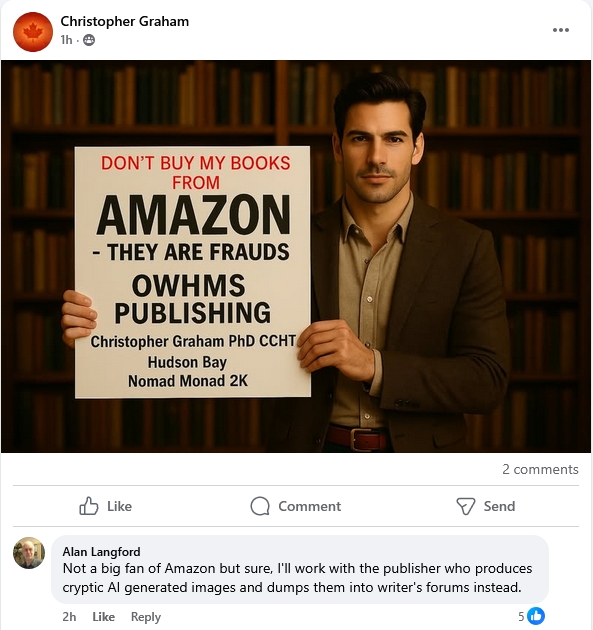
Christopher Graham, or more fully, Christopher William David Graham, posted this gem on a writer’s group, which I commented on:
The Facebook post and my comment
I did a quick search on this fellow and didn’t find much, save for some Linkedin results to posts that have been deleted. The search summaries highlight text like “ONE WORLD HYPNOSIS METAPHYSICS SPIRITUALITY”. OWHMS appears as a page there, but has no “people” and there’s no profile that matches his name and business. Pretty much all that comes up when searching for OWHMS Publishing is his website, which at this point features the image above (sans my comment) and another AI generated image with a similar message. Also of note is that OWHMS was registered as a corporation just a few months ago, on February 25, 2025.
Some time later I received this message:
Facebook Message
Speculating, my best guess is that the LinkedIn posts are gone for TOS violations. Certainly, posting this into the group that he did breaks the group rules (the post has been deleted, but there’s no telling if it was thanks to an administrator or not). If that’s the case he’s likely one of those people who either doesn’t read the rules or just ignores them. I also wonder how you can stick CCHT after your name and still be a “former Certified Clinical Hypnotherapist”. Well, hold on a second… a CCHT is a Certified Clinical Hemodialysis Technician, which is not mentioned anywhere. Whatever.
So, next I did a search for “Certified Clinical Hypnotherapist” and found the Canadian Society of Clinical Hypnosis – Ontario Division at https://csch-od.ca/. As far as I can see, this society doesn’t offer a certification program. Certainly none of its board of directors have the CCHT designation after their name, which leads me to suspect that if anything, the “former” certification was for Hemodialysis. I also found this post on “becoming a certified hypnotherapist in Canada”, which really doesn’t clear much up. Pity I couldn’t find anything equally entertaining on the PhD!
I took a look at his Amazon page (here’s a hint, Christopher: if you don’t want Amazon to sell your books, consider taking them down, maybe?) He’s got 79 titles up there, a random sampling says they contain between 64 and 500 pages. 27 of them appear to be translations, so that’s 52 separate books. With that AI image I kind of expected them to be AI generated, so I popped into a sample to check, and based on a quick scan I think there’s little to no AI involved in this relatively prolific output.
They do all seem to have a common theme of mindfulness, spirituality, etm. But based on that angry text, I might suggest he re-read some of his material. Or meditate. Or take an anger management class. Whatever.
No changes for the July 2025 slightly scary dumb password report. Another drop in access attempts this month. New and notable are a bunch of variations on “rootpassword”. I guess the script kiddies have had some luck with that elsewhere. Looks like there’s also some dumb spam bot trying to use the login form as a comment form. Duh.
Also not logged here is a big spike in attempts to hack through the XML-RPC call. I don’t have stats on those because all calls to xmlrpc.php on my WordPress sites are blocked, blocked, blocked.
I’ve replaced valid login user names with {username}, and names of the site with {site}, old compromised passwords with {compromised} and malware with {malware}. There were also a large number of seemingly random hex strings logged on one site. They’re pretty boring so I’ve collected those as one entry. If you think your username followed by a special character and a year is a secure password, you might be in for a shock. Actually, your user/site name followed by anything is a really bad idea.
These are failed password attempts across my WordPress websites. None of my sites are particularly popular. The amount of real traffic they get is small. So if you have a site and think hackers are ignoring it because few would care, think again. Every site on the net gets attacked like this. Every single one, including yours!
No changes for the June 2025 slightly scary dumb password report. Most notable this month is a sharp drop in access attempts, just 24% of the volume in May, although the diversity of passwords has only dropped to 64% of last month. This corresponds with my theory that spikes in December and April/May correspond to bored university students with nothing better to do than turn into script kiddies and try to wreak a little havoc. This theory has nothing to do with my personal experience as a bored university student. [cough]
I’ve replaced valid login user names with {username}, and names of the site with {site}, old compromised passwords with {compromised} and malware with {malware}. There were also a large number of seemingly random hex strings logged on one site. They’re pretty boring so I’ve collected those as one entry. If you think your username followed by a special character and a year is a secure password, you might be in for a shock. Actually, your user/site name followed by anything is a really bad idea.
These are failed password attempts across my WordPress websites. None of my sites are particularly popular. The amount of real traffic they get is small. So if you have a site and think hackers are ignoring it because few would care, think again. Every site on the net gets attacked like this. Every single one, including yours!

 Sure, like Jen would randomly ask me this question after 15 years or so.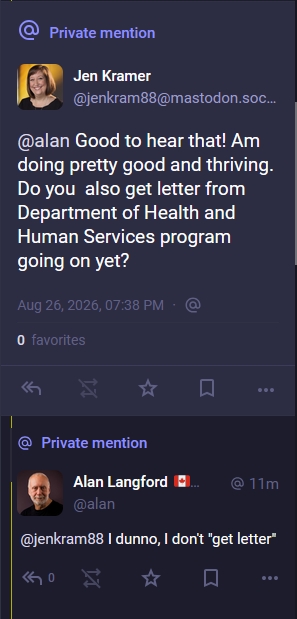





![Email from a scammer. Subject: Re: [book title] From Christopher Joseph if you continue to ignore my messages, | might do something you would regret for the rest of your life. | already have access to your book, and instead of giving it a positive review, | will leave a negative one and damage its reputation. It seems you have forgotten that | have a community of readers, and | can easily influence them to bring your book down. You can try me though. On Wed, 24 Dec 2025 at 2:55PM, Christopher Joseph wrote: Hello [redacted], | came across [book Title], and it immediately struck me as the kind of transformative, deeply personal guide that seekers of self-discovery actively search for but often struggle to find.](https://ambitonline.com/wp-content/uploads/2026/02/scam-2026-02-16.jpg)
![Screen capture of a Facebook message from Christopher Graham, lives in Ottawa, OntarioFormer Certified Clinical Hypnotherapist, NLP practitioner, Well-Being Coach at Canadian Hypnotherapy Metaphysics Spirituality.
The message text is "[obscenity] off loser". In this image the obscenity has been masked by a red blob.](https://ambitonline.com/wp-content/uploads/2025/08/Clipboard-1.jpg)
Recent Comments